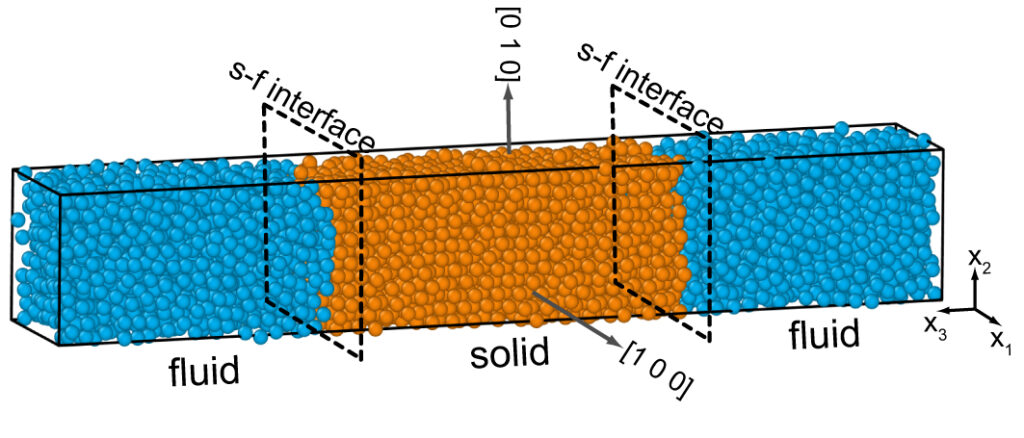
The interaction between deformation, phase transformations, and chemical reactions governs many fundamental Earth processes, including mountain building, earthquakes, magma migration, reservoir stability, and glacier dynamics. As solid materials such as rocks, minerals, and ice deform, they develop non-hydrostatic stresses.
Yet a century-old question remains unresolved: How do these non-hydrostatic stresses affect thermodynamic equilibria?
My research addresses this question by integrating continuum mechanics with molecular dynamics (MD) simulations to determine, in a fully self-consistent manner, how mineral–fluid equilibrium is established under deviatoric stress.
Leveraging high-performance computing, this approach reveals phase equilibria directly from the atomistic response of materials, without relying on prior assumptions of specific thermodynamic potentials. This enables a new, physics-based understanding of stressed systems relevant to Earth and planetary interiors.